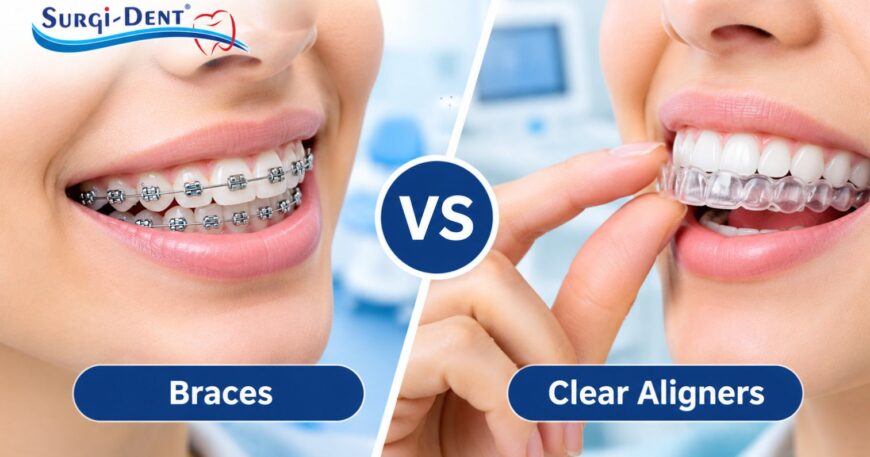

Braces and clear aligners both straighten teeth and correct bite problems. They differ in control, visibility and how much the patient has to do. Fixed dental braces handle complex movements more predictably and work around the clock without relying on you. Removable clear aligners are nearly invisible and easier to clean, but they only work if you wear them 20–22 hours a day. Mild to moderate crowding and spacing often suit aligners. Severe crowding, rotated or impacted teeth, and major bite problems usually call for braces.
How Braces and Clear Aligners Move Teeth
Both treatments rely on the same biology. Steady, gentle pressure on a tooth causes the bone around its root to remodel. Bone is resorbed on the pressure side and laid down on the tension side, so the tooth moves slowly through the jawbone. The periodontal ligament, the fibrous tissue that holds each tooth in its socket, controls this process.
The difference is how the force is delivered.
- Braces use brackets bonded to each tooth and an archwire threaded through them. Your orthodontist changes or adjusts the wire every 4–8 weeks to guide the teeth into position. Elastics (rubber bands), springs or other auxiliaries can be added to correct the bite.
- Clear aligners are a series of custom thermoplastic trays made from a 3D digital scan of your teeth. Each tray moves the teeth a fraction of a millimetre, and you change to the next tray roughly every 1–2 weeks. Small tooth-coloured bumps called attachments are often bonded to some teeth so the trays can grip and rotate them more effectively.
Braces vs Clear Aligners at a Glance
| Factor | Braces (Metal or Ceramic) | Clear Aligners |
| Visibility | Visible (ceramic is less noticeable) | Nearly invisible |
| Removable | No | Yes |
| Daily wear | Fixed, 24/7 | 20–22 hours a day |
| Best suited to | Mild to severe cases, including complex bite correction | Mild to moderate crowding, spacing and some bite issues |
| Typical duration | About 12–30 months | About 6–18 months for suitable cases |
| Check-ups | Every 4–8 weeks | Every 6–10 weeks, often shorter visits |
| Food restrictions | Avoid hard and sticky foods | None, as long as trays come out to eat |
| Oral hygiene | More difficult around brackets | Easier, since you brush and floss normally |
| Main risk | Plaque build-up, white spots, broken brackets | Poor results if you don’t wear the trays enough |
Are Clear Aligners as Effective as Braces?
For the right case, yes. Research comparing the two, including a 2019 systematic review in BMC Oral Health, found that aligners perform similarly to fixed braces for aligning teeth and closing small spaces, and can sometimes finish mild cases faster. The same research found that fixed braces give better control over:
- Root torque and tipping, which means moving the whole root rather than just tilting the crown
- Large rotations, especially of rounded teeth such as lower premolars and canines
- Extrusion, which means pulling a tooth further out of the gum
- Final bite contacts, the way the upper and lower teeth meet when you close
This is why the deciding question is rarely “which is better?” It is “which is better for my teeth?” A clinical examination, X-rays and a bite assessment give you that answer.
When Braces Are Usually the Better Choice
Braces are generally recommended for:
- Severe crowding or cases that need tooth extractions
- Large overbites, underbites, open bites or crossbites, particularly where the jaws are involved
- Impacted teeth, such as canines that need to be pulled into place after an oral and maxillofacial surgery procedure
- Children and young teenagers who may not wear removable trays consistently
- Patients who want a lower-cost option. In Pakistan, metal braces usually cost less than aligners.
If you want braces but prefer a subtler look, ceramic (tooth-coloured) or lingual braces bonded behind the teeth are alternatives. Our guide to the price of teeth braces in Pakistan compares each type.
When Clear Aligners Are Usually the Better Choice
Aligners tend to suit:
- Adults and older teens with mild to moderate crowding or gaps
- Relapse after earlier orthodontic treatment, when teeth have shifted because a retainer wasn’t worn
- People whose work or social life makes visible braces a concern
- Patients with a history of gum disease who need easy access for cleaning, once the gums are stable
- Disciplined patients who will wear trays 20–22 hours a day and remove them only to eat, drink anything other than water, and brush
Comfort, Lifestyle and Oral Hygiene
Comfort: Both cause pressure and mild soreness for a few days after each wire adjustment or tray change. Braces can also rub the cheeks and lips until the soft tissues adapt, and orthodontic wax helps with this. Aligners have smooth edges and usually cause less irritation.
Eating: With braces, avoid hard, sticky and chewy foods such as nuts, toffee, popcorn kernels and hard bread crusts, because they can break brackets. Aligners come out for meals, but you must brush before putting them back in. Otherwise sugar and acid stay trapped against your teeth.
Hygiene: Plaque collects easily around brackets. Poor cleaning can lead to white spot lesions (early enamel demineralisation), cavities and swollen gums. Interdental brushes, a fluoride toothpaste and regular teeth scaling help protect your teeth during treatment.
Risks and Side Effects to Know
Both treatments are safe when an experienced clinician plans and monitors them. Possible side effects include:
- Temporary soreness and tooth sensitivity
- Mild root shortening (root resorption), which is usually minor and can happen with either method
- Tooth decay or gum inflammation if oral hygiene is poor
- Jaw discomfort in some patients. Anyone with existing jaw joint problems should have a TMJ assessment before starting treatment.
- Relapse if retainers are not worn after treatment
Cost of Braces vs Clear Aligners in Lahore
Cost depends on case complexity, treatment length, whether one or both arches need correcting, and the type of appliance. Approximate ranges in Lahore are:
- Metal braces: Rs. 80,000 – 150,000
- Ceramic braces: Rs. 120,000 – 200,000
- Lingual braces: Rs. 160,000 – 220,000
- Clear aligners: Rs. 100,000 for minor cosmetic corrections, rising to Rs. 600,000+ for comprehensive branded aligner systems
Retainers, X-rays and any preliminary treatment, such as tooth fillings or extractions, may affect the final cost. You will get an exact quote after your consultation.
How to Decide: A Simple Checklist
- Get a proper diagnosis. You need a clinical exam, X-rays and a bite analysis, not just a photo of your smile.
- Ask which movements your case needs. Complex movements point to braces.
- Be honest about compliance. If you won’t wear trays for 22 hours a day, braces will give a more reliable result.
- Compare total cost, including retainers.
- Plan for the finish. Some patients combine orthodontics with teeth whitening or a smile makeover once their teeth are aligned.
Patients from PIA Housing Scheme, Johar Town, Wapda Town, Model Town and across Lahore can book an orthodontic consultation with the Surgi-Dent Dental Clinic in Lahore for a personalised treatment plan.
FAQs
Which is faster, braces or clear aligners?
For mild to moderate cases, aligners can finish in about 6–18 months, sometimes faster than braces. For complex cases, braces are often quicker and more predictable, because aligners may need extra “refinement” trays to complete difficult movements. Your actual timeline depends on the problem being treated, not the appliance alone.
Are clear aligners more expensive than braces in Pakistan?
Usually, yes. Metal braces are the most affordable option in Pakistan. Comprehensive clear aligner treatment generally costs more because each tray is custom manufactured from a digital scan. Simple aligner cases for minor crowding can be close in price to ceramic braces.
Do clear aligners hurt less than braces?
Most patients find aligners more comfortable because there are no wires or brackets to rub the cheeks. Both cause mild pressure and soreness for 1–3 days after a tray change or wire adjustment. Over-the-counter pain relief and soft foods usually help.
Can aligners fix an overbite or underbite?
Aligners can correct mild to moderate overbites, usually with attachments and elastics. Severe overbites, underbites and skeletal jaw discrepancies are generally better treated with fixed braces, and some cases need jaw surgery alongside orthodontics.
How many hours a day do I need to wear clear aligners?
You need to wear them 20–22 hours a day. Take them out only to eat, drink anything other than plain water, and clean your teeth. Wearing them less slows tooth movement, can make trays stop fitting, and may extend your treatment.
Am I too old for braces or aligners?
No. Adults of any age can straighten their teeth, provided the gums and supporting bone are healthy. Adult tooth movement can be slightly slower, and any gum disease must be treated and stable before orthodontic treatment begins.
What age is best for braces?
Most children are evaluated around age 7, and comprehensive treatment often starts between 10 and 14, when most permanent teeth have erupted. A pediatric dental specialist can spot early bite problems that may benefit from interceptive treatment.
Can I eat normally with clear aligners?
Yes. Because you remove the trays to eat, there are no food restrictions. Brush your teeth, or at least rinse thoroughly, before putting the aligners back in, so food and sugar aren’t trapped against your enamel.
What foods should I avoid with braces?
Avoid hard, sticky and chewy foods such as nuts, hard candy, toffee, chewing gum, ice and corn on the cob. Cut harder foods such as apples and carrots into small pieces. Limit sugary drinks to reduce the risk of decay around the brackets.
Do I need a retainer after braces or aligners?
Yes. Teeth naturally tend to drift back towards their original positions. Every patient needs a retainer after treatment, either a fixed wire bonded behind the front teeth or a removable clear retainer. Long-term wear, often nightly, keeps the result stable.
Which is better for teenagers?
Both can work. Braces are often preferred for younger teens because they can’t be removed or lost, which guarantees constant wear. Aligners can suit responsible older teenagers, and some systems include wear indicators so parents and clinicians can track compliance.
Can I switch from aligners to braces mid-treatment?
Yes. If teeth aren’t tracking as planned, or if wearing the trays becomes difficult, your orthodontist can switch you to fixed braces to complete the treatment. The reverse is also possible in some cases, for example to finish minor alignment with aligners after braces.

Related Posts